


They say grandparents love their grandchildren more than their own children.
“I feel Noor is a brave player; he plays with complete abandon. I feel both our players have a good chance,” reflected squash legend Qamar Zaman on what’s to come today at the Asian Games in Japan.
The men’s squash singles tournament will be a history-repeating event at the least, and a history-making moment at best in Nagoya, Aichi Prefecture, Japan.
Squash legend Qamar Zaman’s heart is filled with joy as Pakistan’s Noor Zaman will be following in the footsteps of his uncles, while underdog Muhammad Ashab Irfan will play in the semifinals in morning and afternoon sessions.
This is the first time since 2002 that Pakistan will have two semifinalists at the Asian Games men’s singles championship.
The Asian Games squash history is laden with Zaman family contributions, as in 2002 at Busan, Republic of Korea, it was cousins Mansoor Zaman and Shahid Zaman who were in the same position as Noor and Ashab now.
The last time any Pakistani player reached the semifinal at the Games was Aamir Atlas Khan in 2010 in Guangzhou, China.
However, third seed Noor and fifth seed Ashab have heavier stakes than any of their predecessors from Pakistan at this stage because the Asian Games 2026 singles event also offers direct qualification for the Los Angeles Olympics 2028 to the gold medallist.
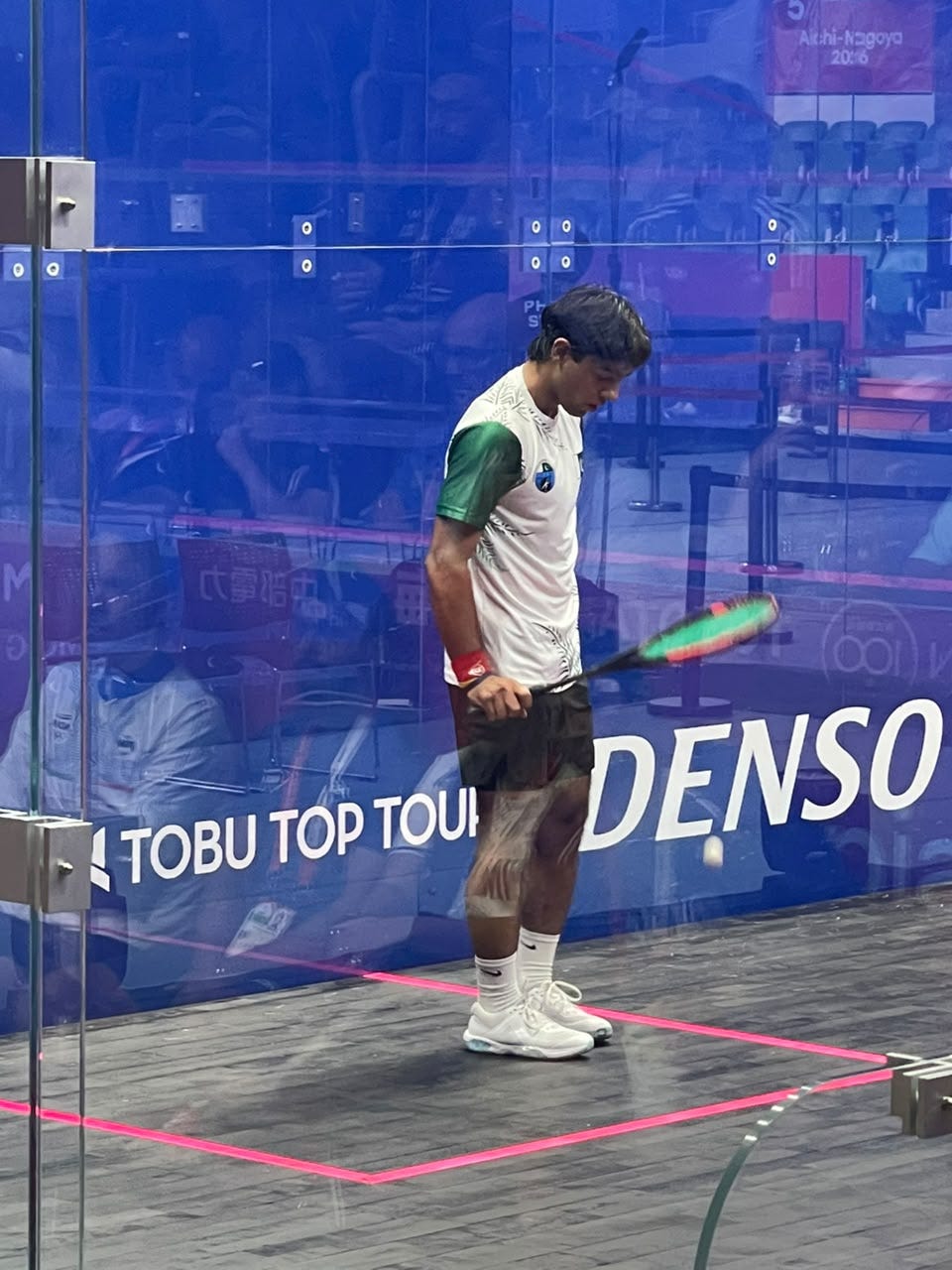
Ashab will face second seed, India’s Abhay Singh, in the first semifinal of the day, whereas the U23 World Champion 2025 Noor will be taking on top seed, Malaysia’s Ng Eain Yow, in the second semi.
“I feel both boys have played really well throughout the individual event. We have had a great result so far, but this was expected,” the former British Open champion Qamar Zaman told Lost on the Desk.
“The semifinals for both Ashab and Noor are tough, and they have a 50-50 chance to win, because the opponents are seeded higher than our boys.
“Noor is doing his best, and Ashab is in great form too. I am hoping that they will reach the final.”
Ashab, who is ranked 49th in the word, has shown his potential when he created an upset in the quarterfinal with a win against India’s seasoned player Veer Chotrani, with world ranking of 38, after conceding the first game 11-6, only to come back and took following games 11-8, 11-3,11-3 to claim a spot among the last-four in 43 minutes.
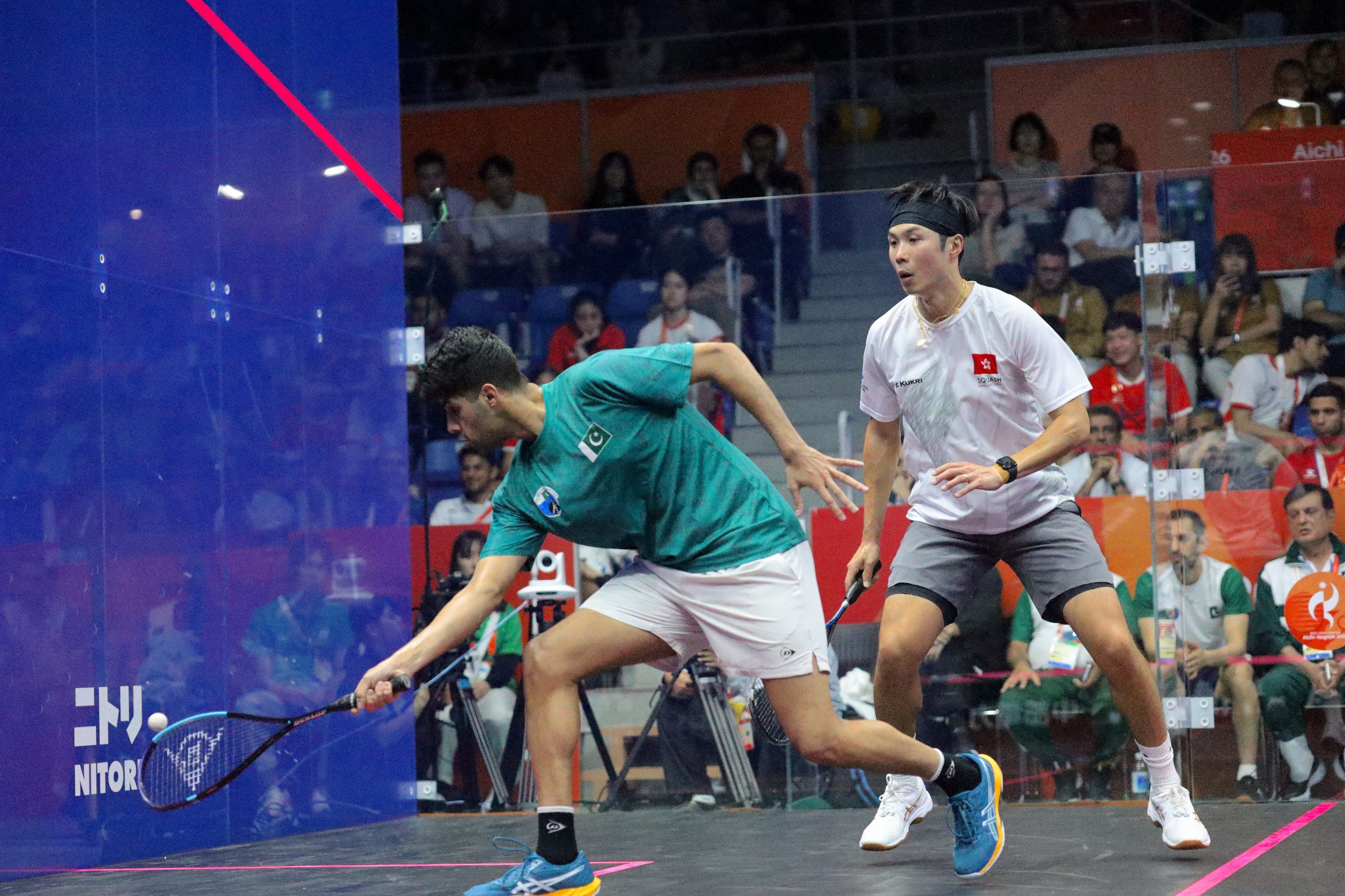
Noor, who is ranked 29th in the world, brought down Hong Kong’s Henry Leung 11-7, 11-6, 3-11, 11-4 in a nail-biter that lasted for 37 minutes.
His Malaysian opponent, six years his senior, is ranked 18th in the world, but there is a solid chance for Noor to advance to the final.
Both players began their singles campaign from the round-of-32.

When specifically asked about how Qamar Zaman feels about Noor’s semifinal and his prediction as an expert, one could feel the measured pride in his voice.
“I feel there is a 60 percent chance in Noor’s favour; it’s 60-40 because his opponent has a better ranking. Now it all depends on Noor. He is brave, he plays with complete abandon, he leaves everything he’s got on the court, but sometimes unlucky shots can become troublesome.
“But he has an edge when it comes to nick shots; he is absolutely brilliant on those, and kills the ball. He has got a great reach, and compared to his last outing, he is performing better. He is in good form as well, although I think he needs to improve on his fitness.
“I am, however, hoping that he wins the gold medal, it will make me extremely happy.”
When it comes to the singles event, the Zaman family has been prolific since the sport was included in the Asian Games program in 1998 in singles and team events.
Pakistan’s record in Asian Games men’s singles event
Pakistan dominated the singles competition at the inaugural squash event at the Asian Games through Zarak Jahan Khan, who defeated compatriot Amjad Khan in Thailand at the 1998 edition.
Noor and Ashab have a chance to repeat this feat too if they both win their semifinals in Japan today.
Noor’s uncle Mansoor Khan finished his tournament with a silver, and Shahid with a bronze in 2002.
Mansoor Khan took the bronze medal in 2006, while Amir Atlas got the silver for the country in the continental Games in 2010, which was also the last time any Pakistani squash player took an individual medal at the Games.
The team squash event only began in 2010, and Pakistan won the gold medal that year.
Mixed game is tricky, but team event is our strong suit
Qamar Zaman was sympathetic toward the Pakistani players who competed in the mixed event and said the result was not good due to their lack of exposure.
Nasir Iqbal and Sehrish Ali lost their mixed doubles round of 16 match to Hong Kong team 2-0, while Asim Khan and Mehwish Ali lost to a Japanese pair 2-1 in their round of 16 match.
“The results in mixed doubles was alright because in Pakistan they do not get the chance to play mixed doubles, and when they competed in the Asian Games, they competed directly in the event without much training and practice for it. Their opponents are better because players from other countries play mixed doubles regularly; it is normal for them unlike for Pakistanis.
But Zaman is very optimistic about Pakistan’s men’s team event which will begin on September 28.
“We have to look forward to the team event because all of our boys are playing very well. We have a 90 percent chance of winning a medal there,” he predicted.
Pakistan took a silver medal in the 2022 Games squash team event with Nasir Iqbal, Asim Khan, Farhan Zaman and Noor Zaman.
On the other hand, Squash team leader in Japan, Sher Bahadur, told Lost on the Desk that he is hopeful for great results from the team and each and every Pakistani player in the competition.
-Fin-