


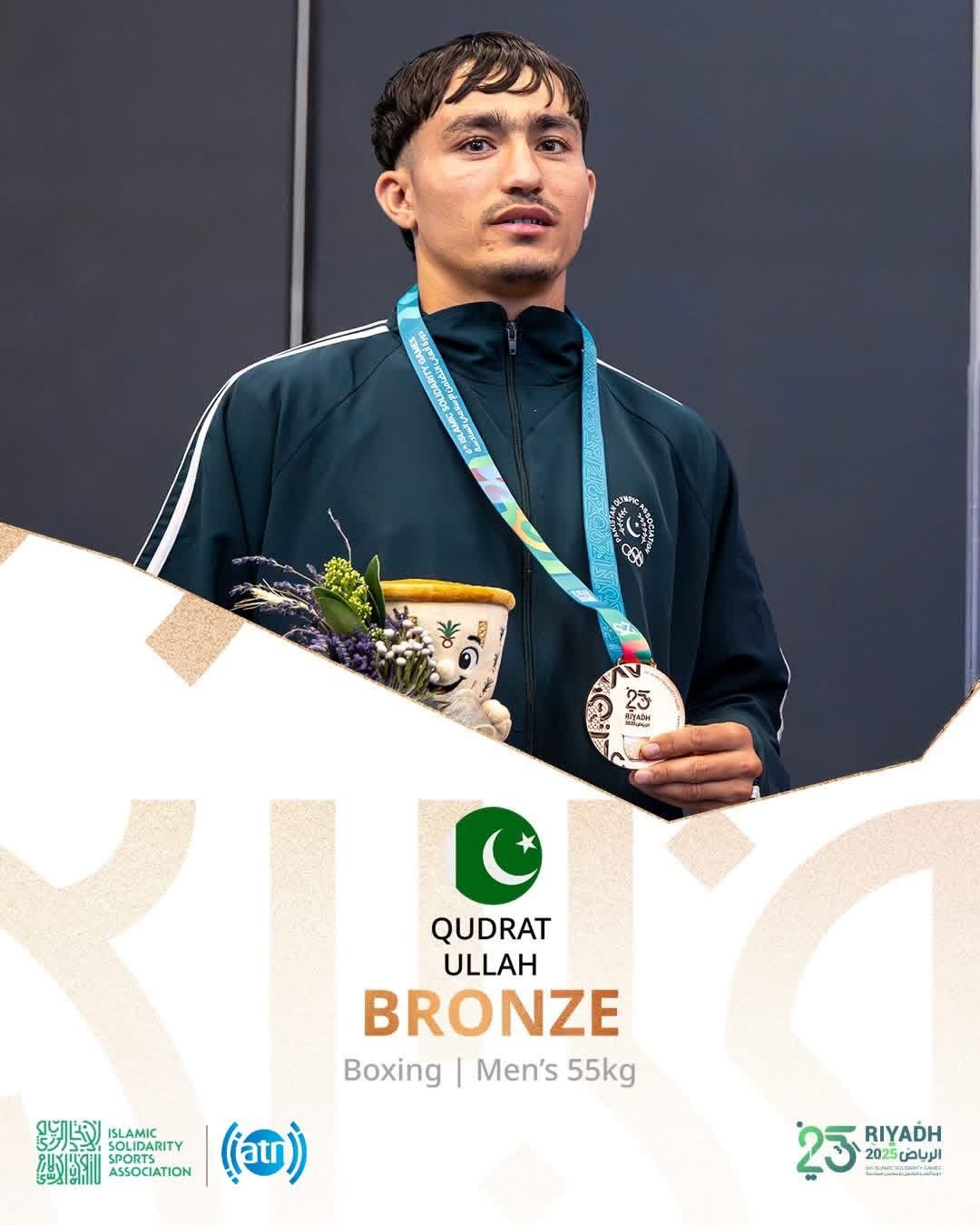
“I was roaming around the streets when fate brought boxing to me,” exclaimed Qudratullah, one of the most underrated performers in the Pakistani sports arena in 2025, looking back at how he began boxing.
Little did he know that, as a 16-year-old at the time, his hard work would result in him becoming the Islamic Solidarity Games medal-winner in a matter of four years.
The 20-year-old took the bronze medal in Riyadh last month in the 55 kg event, but this was his second international medal.
He took his first international medal at the Belt and Road International Boxing Gala 57kg event that took place in China in August.
However, he wants more, his desire is to find his place at the LA Olympics.
It is not as far-fetched a dream given his career progression, so far.
Just this month (December 2025), Qudrat secured a silver medal for his departmental team, the Pakistan Army, during the National Games, where 13 other sides were competing.
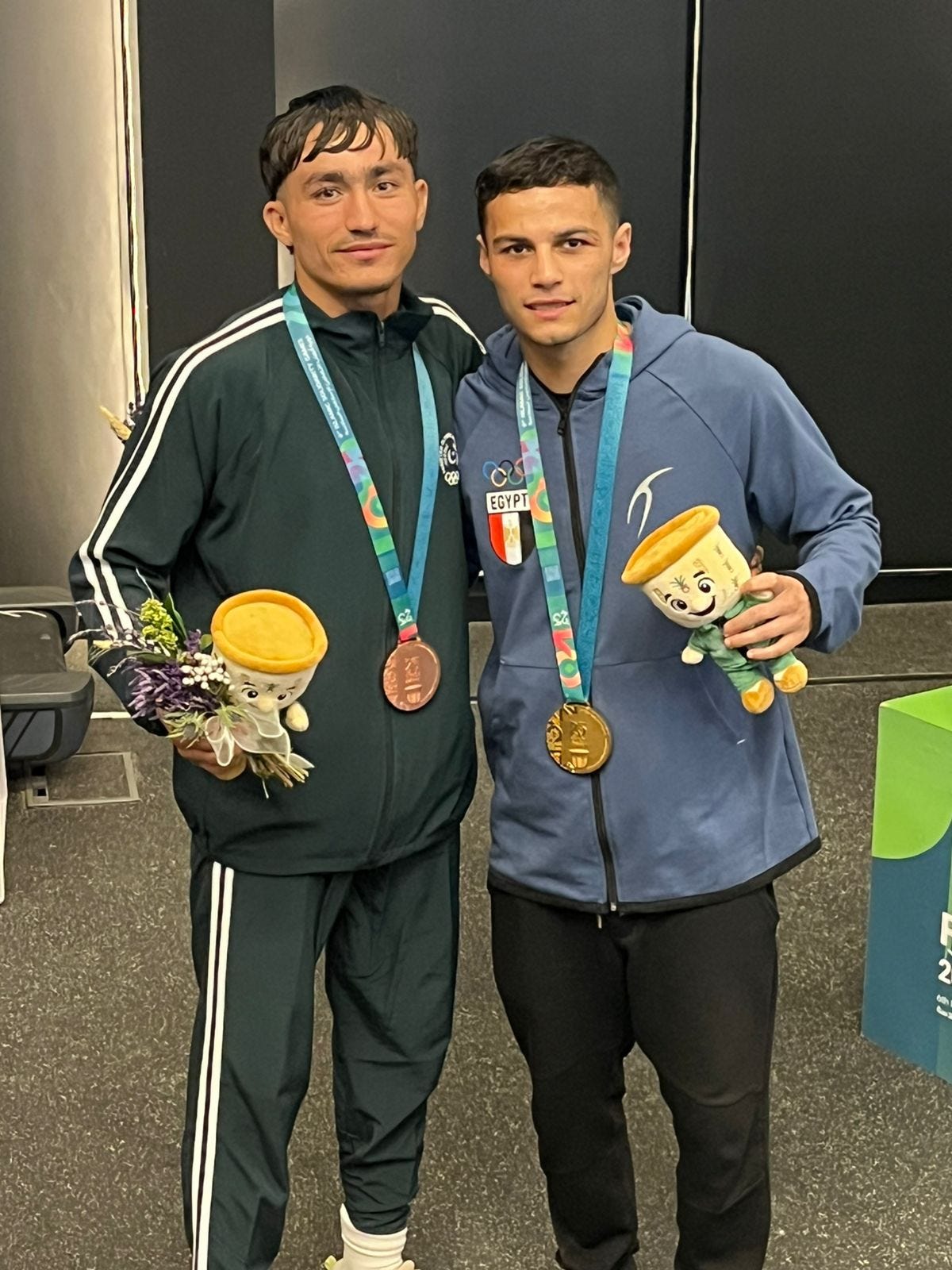
PHOTOS COURTESY: QUDRATULLAH
But the success for the Pashtunabad resident of the city that has given numerous international boxers to Pakistan has been that of fighting odds in real life too.
Qudrat is a Pakistani youth who is following his passion in a society and a staunchly capitalist system that is designed to disempower him and keep him stuck in the cycle of poverty.
In a just world, a 20-year-old talented boxer who has won accolades for the country would not be working as a labourer or a line cook just to make ends meet. This alone makes his achievement at the national and international level all the more impressive.
Qudrat’s trajectory reminds us that a person is not what job they do, but what passion they pursue.
Qudrat is not only working against a system that is rigged against him from the get-go. But he is also a true representation of working-class Pakistanis that constitute around 83.6 million in 2024, according to the World Bank report, who have dreams bigger than this country is equipped to deal with.
He is, after all, also a part of the working-class demographic that contributes the most to society through the work they do. In his case, he is winning laurels through play too.
“I was just roaming on the streets, I was 16 years old then, I was looking for work, I was trying to make sense of our lives,” Qudratullah told Lost on the Desk during the interview that he made time for as he juggled the responsibilities between training regularly, keeping fit, and sharp for boxing competitions, but also working as a line cook at a local restaurant kitchen, where he makes parathas.
The medals and the success that Qudrat has gained are far from the glamour or the money that a boxer with accolades like his should have.
VC: Qudratullah, who is in blue trunks
He needs to work at least two jobs to make ends meet, take care of his family, and stay fit as a professional athlete.
He said that even now, two of his brothers work as labourers, and he has been a labourer for most of his life.
“I was working back then too, I was working at a hotel as a labourer there, but my coach and ustad (mentor and teacher) Moulavi Ishaq Muhammad noticed me, and he invited me to box.
“That was the luckiest day for me as boxing chose me, the sport gave me a greater purpose,” explained Qudrat, who trains at Al Muslim Sports Academy.
“I remember when I first went to the club, I just chose to show up and see what happened. I didn’t have the shoes or gloves, but my Ustad, Moulvi Ishaaq, was kind to me. He introduced me to the sport and gave me the gloves and shoes, and he took care of me.
“He is the reason why I am getting these medals, because he believed in me. He did everything for me, and he never charged fees for me, which was a massive help.”
But Qudrat also remembers how difficult it was for him to prove his mettle even at the club level with many talented boxers training there.
“It was a challenge, there were difficulties at home, we weren’t doing well and there was extreme economic constraints, so the home life was tough, but even at the club, I had to train harder and harder to prove myself, to show my teacher that I am learning and then there were older, senior boxers there too, who were my competition. So overcoming those difficulties was key for me. And somehow, I think due to my hard work and persistence, I managed to survive.
“It really was about survival, and it still is about survival.”
The hard work, fueled by the desire to make his life better, Qudrat made his national under-age debut in 2022 as he competed at the U18 and U17 National Boxing Championship in Karachi, where he ended up bagging silver medals in both U17 and U18 events to mark his arrival at the national circuit.
Qudrat then competed at the 34th National Games that took place in Quetta, representing Balochistan, later became a three-time All-Quetta champion in his weight category as well in the course of just two years, all the while working as a labourer when not training and competing.
This captured the attention of Major Irfan Younis of the Pakistan Army and the secretary of the Pakistan Boxing Federation, who helped him get a departmental job with the Army, and Qudrat made him proud by winning the gold at the 4th Inter-Department National Boxing Championship 2024, which featured the crème de la crème of Pakistani boxers.
But 2025 was truly Qudrat’s year as he was finally crowned the national champion at the 41st National Boxing Championship, and he managed to take the Inter-Services Championship gold medal too, along with international successes in China and at Islamic Solidarity Games in Riyadh.
“It has been a good year, I know I competed well both at the national events, but also in international events, I gave a tough time to my opponents, like Cuban and Uzbek boxers in China, and these are the athletes who are training to compete at the Olympics.
“I feel I have the fight in me and the skill of the same calibre as them, but there is not much support for it. I joined the Army two years ago, and I can’t thank Major Irfan enough for it. He has helped me with international events, and we have delivered almost 100 per cent results if you look at it.
“I say 100 per cent because I have won two medals in both international events I was sent to.
“But the truth is that we need government support in terms of money and facilities along with expertise, we need the systems that can help us, we need stability,” said Qudrat, who craves for professional camps, international coaches and tours, and just having enough to solely focus on training for events without worrying about how to meet his day-to-day expenses on a shoe-string budget.
“I had my self belief, in China at the Belt and Road International Boxing Youth Gala we had competitors from 26 countries, and it was such a learning experience for me, it gave me confidence, and then I went to the Islamic Solidarity Games where 57 countries were competing at the event, so that was tougher, but I kept my faith that I could deliver. When push came to shove, I gave my all and fought, and survived in the ring, that’s what I did.
“I am just grateful that Allah blessed me with success and the medal.”
Survival is more of a skill than an instinct that Qudrat has mastered in an unstable economic and political environment, like many young boxers at his club.
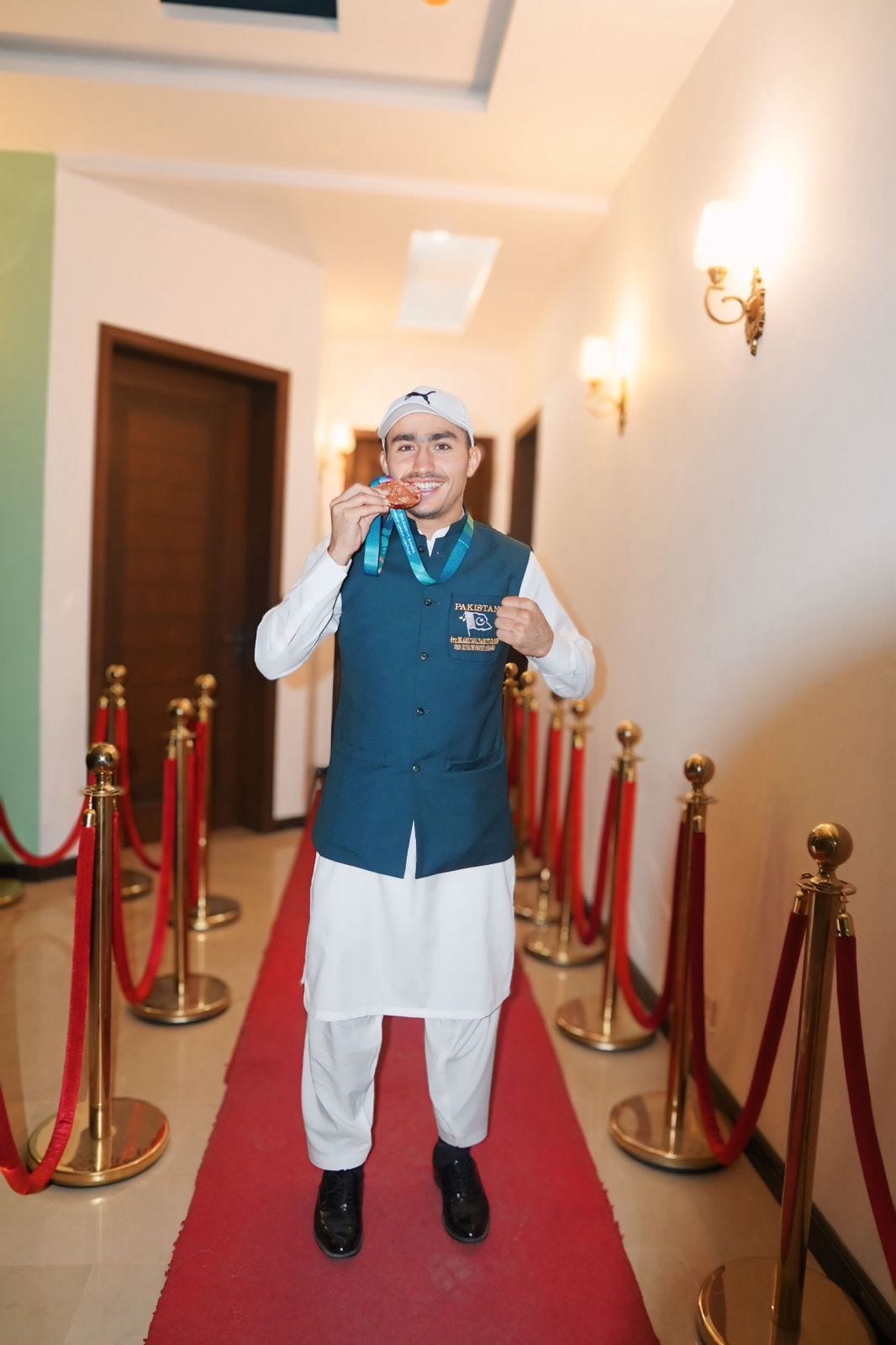
He emphasized that many others come from humble backgrounds like his, boxers that have no money for gloves or shoes or kits, and yet they persevere.
He points out how poverty is a blunt force that actively stops youngsters like him from progressing in life and pursuing careers in things they are passionate about.
“There is so much talent in Pakistan, but poverty is a real thing; it simply comes down to feeding ourselves or sports, but still we give results, “ pointed out Qudrat, who has been promised Pakistani Rupees 2 million by the Pakistan Sports Board for his bronze medal in Riyadh but has not seen even a penny of it.
“My ultimate dream is to compete at the Olympics, but that needs a proper diet, and we need government support for that kind of preparation.
“Like right now, I have a job with the Army, but I also need to work as a labourer because I need to make ends meet and then save something for myself for a rainy day.
“I give half of my salary at home to my family, then there is half left for me to take care of myself as an athlete, take care of the expenses and then to save some, but it is not a lot of money that can help me reach that dream.
“However, I will do everything I can to compete at the Olympics and win a medal too.”
When asked if he has a special diet, he laughed and said he has no specific diet, but he has the hunger to get to the top. Even at the National Games in Karachi, a city that he visits often, he felt that the goal of boxers in Pakistan is to grow and beat the odds, in and outside the ring.
We asked him what the competition at the top level is like, especially when it comes to the rivalry between departmental sides, the Army and Wapda, he was quick to smile and say that boxers just want to have fun.
“It is all very friendly, and we have so much fun in the bigger events, we meet and it doesn’t really matter what happens in the ring, there is a lot of respect and sense of community among us, like the Wapda boxer who beat me in the final at the National Games, we were like brothers right after the fight, the aim is to grow at the end of the day,” explained Qudratullah.
Boxing as a coping mechanism for a community
Moulvi Ishaq reminisced about the first time he saw Qudratullah, “I saw him, and I thought he had that fight in him; he can become a good boxer.
“I saw him on a street, and I thought he should come to our club. When he showed up, I put him on training and gave him a week to see how he responds to the training.
“I was happy to see him take an interest in boxing, and he was eager to learn, he continued to improve with each sesssion.”
Ishaq has an eye for good boxers, and in the last National Championship alone, he had five boxers from his club who were competing and winning medals.
He has spent decades building and serving the community in Quetta as a boxer first and then as a coach.
“I have been boxing since 1990. I had been a boxer myself, and in a short span of time, I became the champion in Balochistan and took medals, but then I switched to coaching, and I opened my own club in 2001.
“I named it Red Dragon because I was inspired by Chinese martial arts, but soon I changed it to Al Muslim Sports Academy because people would often get confused by Red Dragon, and ask me a few times what the name meant.
“I think Al Muslim was simple enough for people to remember, and it helped,” said Ishaaq, who now has at least 120-130 athletes training with him.
He explained that he has three sessions of training each day, the first one starts right after Fajr prayers, then the next after Zuhr, and the third after Maghrib, which is where Qudrat was when we interviewed him.
Ishaq has a long commitment to the community, especially to the youngsters, who he feels need direction and resources to become stars.
Ishaq’s model of helping youngsters like Qudrat is simple; he charges money from those who come to his academy for recreation and fitness, and who can afford to pay fees because they are coming from well-to-do families.
The money he gets from the fees paid by the rich people goes into helping the athletes who need support.
“It is like a scholarship program. I pick an athlete and see how they do on the local, club level, then district level, and when I see they have the talent and potential to become better at boxing, I support them with everything. Many boys from my club have gone on to compete at the national and international level, and departmental teams pick them. So it is a breeding ground of future champions from Balochistan,” said the Wapda Wushu team coach.
He highlighted that the economic stability of the people of Quetta depends on the stability of the borders that Pakistan shares with Afghanistan, and often in times of political upheavals, it is the youth that suffers the most in his city, and athletes usually take up odd jobs to support their families because there are no other options for them.
In a precarious environment like that, he feels his academy can serve as a haven for the youth. Therefore, he carries on his mission because, through sports, there is a way out of volatile circumstances. He feels proud when he sees his athletes go abroad and win medals, like Qudrat and others, because it gives him hope.
“There is an alternative, sports can provide a life they deserve, at least it gives us that hope, and that is a very good reason to continue doing what we do,” concluded Ishaq.